题目大意
小Z所在的城市有$N$个公交车站,排列在一条长为$N-1$公里的直线上,从左到右依次编号为$1$到$N$,相邻公交车站间的距离均为$1$公里。
作为公交车线路的规划者,小Z调查了市民的需求,决定按以下规则设计线路:
1.设共有$K$辆公交车,则$1$到$K$号车站作为始发站,$N-K+1$到$N$号车站作为终点站。
2.每个车站必须被一辆且仅一辆公交车经停(始发站和终点站也算被经停)。
3.公交车只能从编号较小的车站驶向编号较大的车站。
4.一辆公交车经停的相邻两个车站间的距离不得超过P公里。
注意“经停”是指经过并停车,因经过不一定会停车,故经停与经过是两个不同的概念。在最终确定线路之前,小Z想知道有多少种满足要求的方案。由于答案可能很大,你只需求出答案对$30031$取模的结果。
题目分析
比较简单的轮廓线Dp。
其中题目给出的$p$即为轮廓线。
设状态$f[i,S]$为最靠左的公交车在$i$位置,当前$p$个位置的覆盖情况为$S$的方案数。
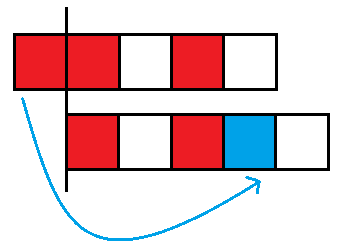
如图,转移的过程即为将最左边的公交车移动到右边任意一个格子。
因此,$f[i,from]\rightarrow f[i+1,to]$转移的条件即为:设$from$左移一位,高位超出的减掉,低位补$0$得到的状态为$from’$,则$from’\,xor\,to$仅包含一个$1$。
但是这样转移状态量偏大,用矩阵是存不下/超时的。
因此我们先对合法状态编号,去掉不合法状态。
$S$是合法状态条件为:最高位为$1$,$S$中包含$k$个$1$。
其中起始状态最高位有$k$个$1$。
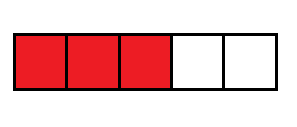
结束状态本应是最低位有$k$个$1$,但因为规定了最高位为$1$,故结束状态与起始状态一样,均为最高位有$k$个$1$,后面的$0$已唯一确定。
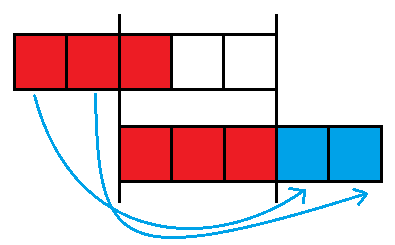
因为每次都是从$i$转移到$i+1$,故转移关系图可以看做是一个有向图,转移$n-k$次得到答案,故使用矩阵快速幂优化转移即可。
代码
1
2
3
4
5
6
7
8
9
10
11
12
13
14
15
16
17
18
19
20
21
22
23
24
25
26
27
28
29
30
31
32
33
34
35
36
37
38
39
40
41
42
43
44
45
46
47
48
49
50
51
52
53
54
55
56
57
58
59
60
61
62
63
64
65
66
67
68
69
70
71
72
73
74
75
76
77
78
79
80
81
82
83
84
85
86
87
88
89
90
91
92
93
94
95
| #include<algorithm>
#include<iostream>
#include<iomanip>
#include<cstring>
#include<cstdlib>
#include<vector>
#include<cstdio>
#include<cmath>
#include<queue>
using namespace std;
inline const int Get_Int() {
int num=0,bj=1;
char x=getchar();
while(x<'0'||x>'9') {
if(x=='-')bj=-1;
x=getchar();
}
while(x>='0'&&x<='9') {
num=num*10+x-'0';
x=getchar();
}
return num*bj;
}
typedef long long LL;
const int maxn=205,mod=30031;
struct Matrix {
LL n,m,a[maxn][maxn];
Matrix(LL n,LL m) {
init(n,m);
}
Matrix(LL n,LL m,char E) {
init(n,m);
for(int i=1; i<=n; i++)a[i][i]=1;
}
void init(LL n,LL m) {
this->n=n;
this->m=m;
memset(a,0,sizeof(a));
}
LL* operator [] (const LL x) {
return a[x];
}
Matrix operator * (Matrix& b) {
Matrix c(n,b.m);
for(int i=1; i<=n; i++)
for(int j=1; j<=b.m; j++)
for(int k=1; k<=m; k++)
c[i][j]=(c[i][j]+a[i][k]*b[k][j])%mod;
return c;
}
void operator *= (Matrix& b) {
*this=*this*b;
}
Matrix operator ^ (LL b) {
Matrix ans(n,m,'e'),a=*this;
while(b>0) {
if(b&1)ans=ans*a;
a*=a;
b>>=1;
}
return ans;
}
};
int Count(int s) {
int cnt=0;
while(s) {
if(s&1)cnt++;
s>>=1;
}
return cnt;
}
int n,k,p,cnt=0,Start,state[1025];
bool Check(int from,int to) {
from=(from<<1)&((1<<p)-1);
int tmp=from^to;
if(tmp==0)return 0;
return tmp==(tmp&(-tmp));
}
int main() {
n=Get_Int();
k=Get_Int();
p=Get_Int();
for(int i=1<<(p-1); i<(1<<p); i++)
if(Count(i)==k) {
state[++cnt]=i;
if(i==(((1<<k)-1)<<(p-k)))Start=cnt;
}
Matrix M(cnt,cnt);
for(int i=1; i<=cnt; i++)
for(int j=1; j<=cnt; j++)
if(Check(state[i],state[j]))M[i][j]=1;
M=M^(n-k);
printf("%lld\n",M[Start][Start]);
return 0;
}
|