题目大意
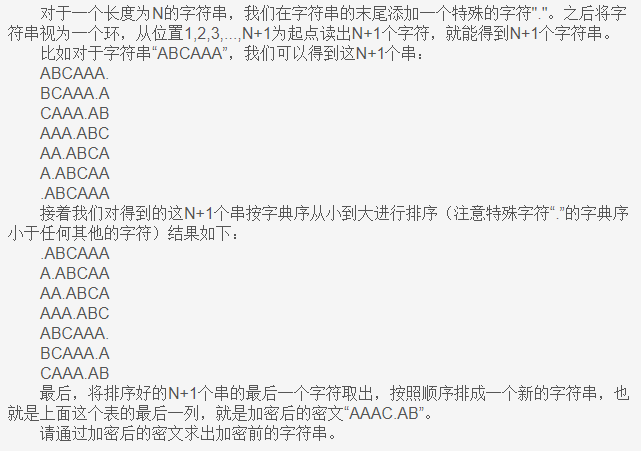
题目分析
根据题目给出的末尾,可以得到整个串的元素组成。
不难想到可以通过字典序排序得到排好序的串的首位字符。
因此将题目给出的末尾字符编号,将其按照字符作为第一关键词,编号作为第二关键词重排序,得到的就是排好序的串的首位字符(第二关键词排序的原因类似后缀平衡树的思想,通过已经有的后面位字符确定后面的字典序大小)。
因此我们得到了每个串的开始位置与结束位置:
考虑将原串扩展两倍。
$AB\mid CAAA*AB\mid CAAA*$
发现每个末尾字符($B$)对应的是开头字符($C$),也正是其下一个字符开头串的字典序。
故我们即可从首字母开始向后找到下一个字符串迭代直到结束。
代码
1
2
3
4
5
6
7
8
9
10
11
12
13
14
15
16
17
18
19
20
21
22
23
24
25
26
27
28
29
30
31
32
33
34
35
36
37
38
39
40
41
42
43
44
45
46
47
48
49
50
51
52
| #include<algorithm>
#include<iostream>
#include<iomanip>
#include<cstring>
#include<cstdlib>
#include<climits>
#include<vector>
#include<cstdio>
#include<cmath>
#include<queue>
using namespace std;
inline const int Get_Int() {
int num=0,bj=1;
char x=getchar();
while(x<'0'||x>'9') {
if(x=='-')bj=-1;
x=getchar();
}
while(x>='0'&&x<='9') {
num=num*10+x-'0';
x=getchar();
}
return num*bj;
}
const int maxn=200005;
struct sequence {
int x,id;
bool operator < (const sequence& b) const {
return x<b.x||(x==b.x&&id<b.id);
}
} a[maxn];
int n;
int main() {
n=Get_Int();
Get_Int();
for(int i=0; i<=n; i++) {
a[i].x=Get_Int();
a[i].id=i;
}
sort(a,a+n+1);
int now=a[0].id;
for(int i=1; i<=n; i++) {
printf("%d ",a[now].x);
now=a[now].id;
}
return 0;
}
|